
A leadership reflection tool for your team (or yourself)
After two years of posting regularly on LinkedIn, I've learned a great deal about what resonates with school leaders—and what doesn't. The conversations have shaped how I think about supporting aspiring heads, and the thoughtful people who show up consistently make it all worth it.
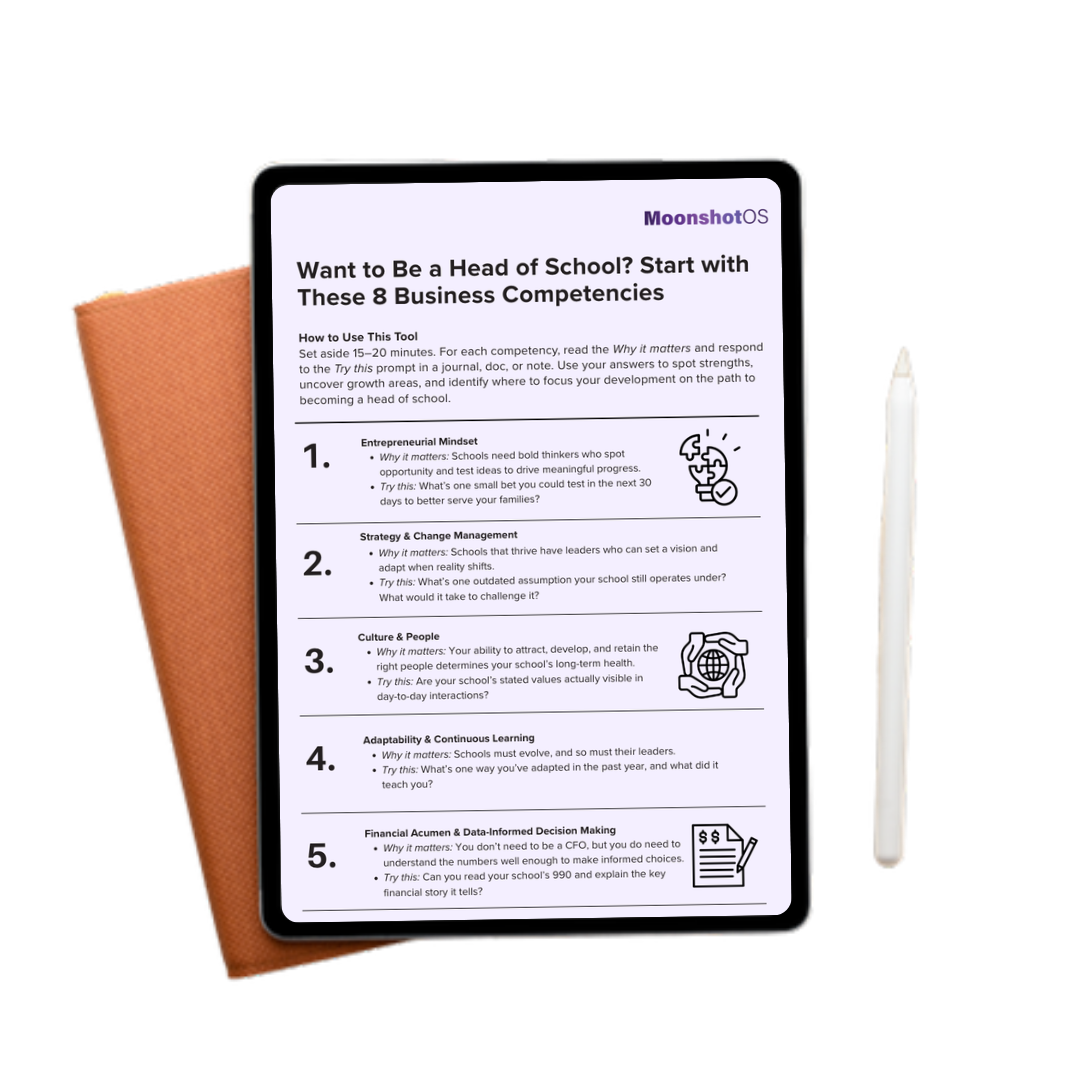
Every now and then, a post strikes a chord. Last week, that happened when I shared a PDF titled "Want to Be a Head of School? Start with These 8 Business Competencies."
The impressions skyrocketed. More importantly, I heard from aspiring heads, current heads, and—perhaps most telling—a board member who reached out asking for a copy.
That response told me something important: there's a real hunger for honest, practical guidance on the business side of school leadership. And that's exactly what this post is about.
Why Business Competencies Matter for Aspiring Heads of School
The conversation around becoming a head of school tends to focus on vision, culture, and mission. Those things matter. But the job has expanded significantly, and the business side of running an independent school is now central to the work, not peripheral to it.
The challenge isn't that aspiring leaders lack the ability to develop these skills. It's that the path to the head's office rarely includes a structured introduction to financial acumen, enrollment strategy, or operational management. Most leaders figure it out on the fly, after they've already taken the role.
That learning curve is steep, and it doesn't have to be.
The PDF That Started the Conversation
The reflection tool I shared on LinkedIn walks through eight core business competencies that every head of school needs to understand and develop over time. It's designed as a self-assessment—not a test, not a certification, just an honest prompt to help aspiring leaders identify where they're strong and where to focus next.
It takes about 15 to 20 minutes to complete, and the clarity it surfaces is worth every minute.
The 8 Business Competencies Every Head of School Needs
These competencies anchor everything inside Moonshot Lab. They were developed after conversations with hundreds of heads of school who described the same gap: nobody prepared me for this part of the job.
They fall under two pillars: Leadership (the mindset and skills to guide people and lead change) and Operational Excellence (the systems and strategies that drive sustainability and growth).
Here's a brief look at each one.
1. Strategy and Change Management
Independent schools are operating in a more complex environment than they were even five years ago. A head of school needs to think strategically about where the school is going and how to bring faculty, staff, families, and the board along for the ride. Strategy isn't a document—it's a practice.
2. Culture and People
Culture is the operating environment for everything else. Heads of school set the tone for how adults work together, how conflict gets resolved, and how the school's values show up in day-to-day decisions. This is leadership in its most visible form.
3. Adaptability and Continuous Learning
The pace of change in independent schools—enrollment pressure, demographic shifts, the rise of AI—means that the leaders who thrive are the ones who can learn quickly and adjust without losing their footing. Adaptability isn't a soft skill. It's a strategic asset.
4. Entrepreneurial Mindset
This is one that surprises people. But the most effective heads of school I've worked with think like entrepreneurs. They see constraints as design problems. They ask different questions. They're not afraid to try something that hasn't been done at their school before.
5. Financial Acumen and Data-Informed Decision Making
You don't need a finance degree to lead a school well, but you do need to understand how the numbers work and what they're telling you. Heads who struggle with financial acumen often make decisions based on incomplete information—or worse, they defer entirely to the CFO and miss the strategic conversation happening in the data.
6. Marketing Strategy
Enrollment starts with visibility, and visibility requires intentional marketing. Aspiring heads need to understand how a school's brand, messaging, and outreach strategy connect to the families it's trying to attract. This is no longer someone else's job—it flows directly from strategy.
7. Revenue
Independent schools have more revenue levers than most leaders realize. Tuition is the obvious one. But auxiliary programs, facility rental, summer programs, and strategic partnerships all contribute to the financial picture. Understanding and expanding the revenue model is a core leadership responsibility.
8. Operations
Operations is the infrastructure that makes everything else possible. Scheduling, staffing, facilities, systems, and workflows—when operations run well, nobody notices. When they don't, everyone does. Aspiring heads who build fluency here have a significant advantage.
How to Use This as a Reflection Tool
The PDF I shared on LinkedIn isn't a ranking system. No score tells you whether you're ready to be a head of school. What it does is help you see clearly—which of these competencies feel like strengths, and which ones would benefit from more attention.
That kind of honest self-assessment is rare. Most leadership development focuses on the things people are already good at. This tool is designed to surface the gaps in a way that's constructive, not discouraging.
A Few Questions Worth Sitting With
As you work through the reflection, consider these:
Where do you feel most confident when these topics come up in a leadership conversation?
Where do you tend to defer to someone else—and is that deference by choice or by default?
If you became a head of school tomorrow, which of these would you want a stronger foundation in?
There are no wrong answers. But the honest ones are the useful ones.
What Comes Next
If you're an aspiring head of school—or a current head looking to sharpen the business side of your leadership—this is the work that matters.
You can grab a copy of the reflection tool and start working through it in about 15 to 20 minutes. It's a practical starting point, and it's free.
These eight competencies are also the foundation of everything inside Moonshot Lab—the membership community I built specifically for current heads of school and aspiring leaders who want to develop real business fluency. If the self-assessment surfaces areas you want to go deeper on, Moonshot Lab is where that work happens.
Learn more about Moonshot Lab.
And one more thing: I'm genuinely curious what else would be helpful. What other tools, frameworks, or conversations would support you in your leadership journey? I'd love to hear from you.