
Why Strategy Stalls – And How Leaders Can Fix It
Strategy shows up in every school I visit.
Leaders care deeply about it. They talk about it in board meetings, reference it in faculty conversations, and work hard to build plans that reflect real vision. But they're often frustrated by the same thing: how hard it is to move from intention to execution.
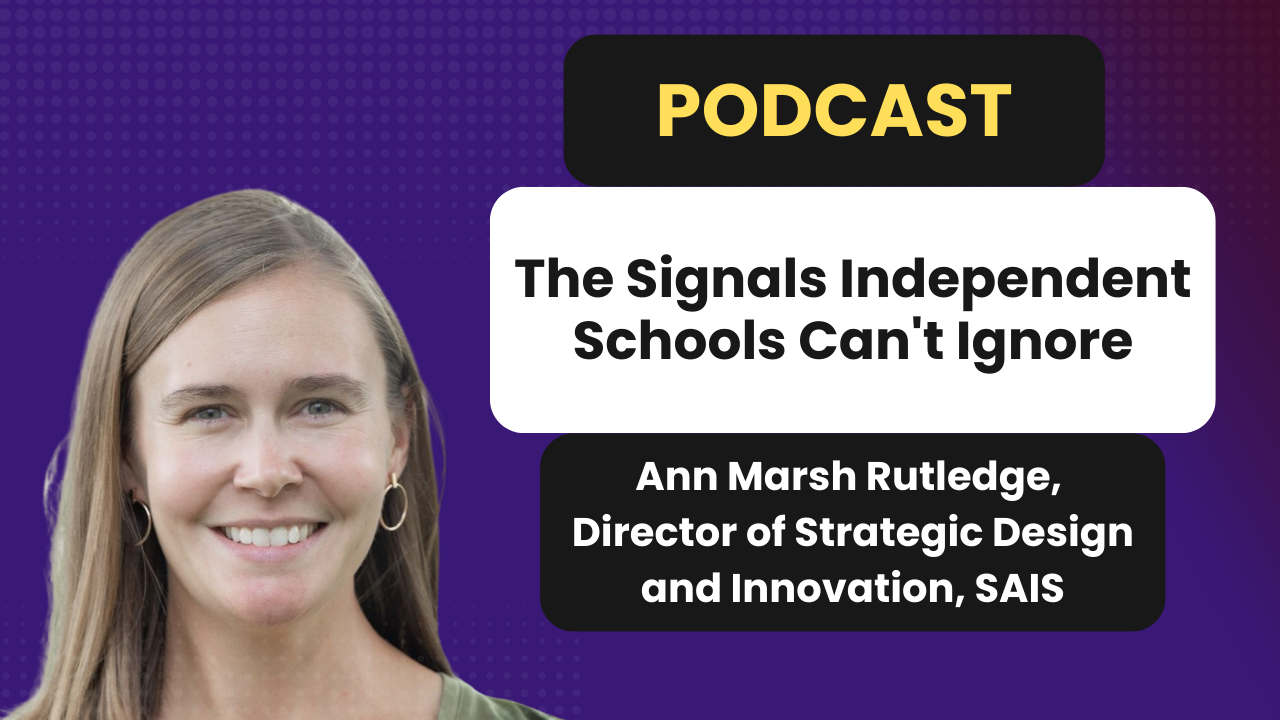
That frustration came through clearly in this week's episode of the Independent School Moonshot Podcast, "The Signals Independent Schools Can't Ignore," featuring Ann Marsh Rutledge, Director of Strategic Design and Innovation at SAIS. Ann Marsh spends her days helping schools close that gap, and she brought a level of clarity to this conversation that I think a lot of leaders need to hear right now.
Her central point: strategy doesn't stall because teams don't want it. It stalls because daily demands end up overwhelming the strategic work.
That's the real problem. Not ambition. Not commitment. Structure.
The Daily Demand Problem
Here's what actually happens in most schools: a leadership team completes a strategic planning process. They have a document, a vision, a set of priorities. And then Monday arrives.
There are enrollment calls to make, a facilities issue to address, a faculty concern to navigate, a board member with a question. By Thursday, the strategic plan is sitting in a shared drive somewhere, untouched.
No one made a decision to deprioritize strategy. It just got buried. The urgent pushed out the important, and it will keep doing that unless something changes structurally.
This is precisely why a school operating system matters.
The work I spend my days helping schools build is a clear, reliable structure that turns strategy into real movement. When schools have a system they can depend on, leaders stop fighting the same fires every week and start making steady progress toward their long-term goals. Daily demand fills the schedule, and without intentional structure, strategic work keeps getting pushed to "when we have time," which rarely arrives.
Strategy as a Habit, Not an Event
What I appreciate most about Ann Marsh is that she doesn't talk about strategy as a grand, abstract exercise. She talks about it as a habit. Something leaders build through predictable, intentional cycles.
That framing matters. A lot of schools treat strategic planning as an event: a two-day retreat, a consultant engagement, a document that gets produced and approved. And those things have value. But strategy as a habit is different. It's ongoing. It's built into how the school meets, plans, and communicates every week.
She laid out a simple framework for thinking about this:
Start with a clear three-year horizon. Where are we going, and why does it matter? This is your directional anchor. It gives the leadership team a shared sense of destination and a lens for evaluating every major decision.
Break that into a focused one-year plan. What must shift in the next 12 months to move the school closer to that horizon? This is where strategic intent meets operational reality. It forces prioritization, which is always harder than it sounds.
Then zoom in to 90-day cycles. These are practical, visible, achievable blocks that a leadership team can actually execute. Ninety days is long enough to make meaningful progress and short enough to maintain urgency and accountability.
This three-level structure, long-term vision, one-year priorities, and 90-day sprints, is exactly where a school operating system earns its keep.
What a Strong Operating System Actually Does
A strong operating system takes all of those pieces and turns them into a weekly rhythm leaders can trust. It creates the structure Ann Marsh is talking about: a predictable cadence that protects strategic work from getting buried under daily demands.
With the right operating system in place:
Every weekly leadership meeting becomes a strategic meeting. Not a status update, not a problem-solving session, but a deliberate conversation about the school's priorities and progress.
Ownership and accountability are clear. Every initiative has a name attached to it. Every 90-day project has a lead. There's no ambiguity about who's responsible for what.
Priorities stay visible. The leadership team isn't trying to hold the school's strategy in their heads. It's in front of them, regularly referenced, regularly updated.
Signals get integrated into decisions, not saved for later. When enrollment trends shift or parent feedback surfaces a pattern, that information has a place to land. It doesn't get noted and forgotten.
The school's language, expectations, and vision stay aligned. Over time, this shared language begins to show up everywhere: in faculty culture, in parent communication, in the clarity families feel when they ask, "What does this school stand for?"
That last one is easy to underestimate. Alignment isn't just an internal benefit. It shows up in the confidence families have in the school's direction, in how faculty talk about their work, and in whether the brand feels coherent from the outside.
Why This Moment Requires More Than Intention
Ann Marsh said it plainly: if strategy isn't built into the school's operating system, it won't happen. Not because leaders don't care, but because the structure wasn't there to support it.
That's worth sitting with. It's not a failure of commitment. It's a structural gap.
And the stakes for that gap are rising. Enrollment patterns are shifting. Parent expectations have changed. Hiring dynamics are creating new pressure on school culture and retention. These are not slow-moving signals. Schools need to be paying attention to them continuously, not during an annual retreat.
In that environment, strategy cannot be a once-a-year activity. The schools that grow over the long term are the ones that build strategy into the way they meet, plan, and communicate every single week. They don't just have a plan. They have a system that keeps the plan alive.
That's the difference between intention and execution. And that's the work worth doing.
If you're curious to hear the full conversation, including the specific signals Ann Marsh says independent school leaders need to pay closest attention to right now, you can find it through any of the options below.
Visit the Episode Page Listen on Apple Podcasts Listen on Spotify Watch on YouTube