
If You Rewrote Your School’s Strategy Today…
I spend a lot of time talking with leadership teams about strategy.
Lately, I have noticed a recurring pattern. And it is one worth naming directly.
When a school hits a rough patch, whether it is an enrollment dip, a softening local economy, or a demographic shift that feels closer than it used to, the instinct is almost always to look inward.
That instinct is not wrong, exactly. You have to look at your programs. You have to assess what is working and what has run its course. That kind of honest internal review is part of good leadership.
But the trap I see is that many schools hold tight to the same playbook they have used for years to run those programs. The same calendar. The same decision-making structure. The same assumptions about what families want and why they choose you.
It is an understandable reaction. In times of high pressure and uncertainty, we naturally reach for the tools that made us successful in the past. There is a deep comfort in the familiar when the outside world feels volatile.
The risk is that we try to solve new external problems with old internal logic. We end up protecting a process rather than ensuring our future relevance.
The Mirror vs. the Window
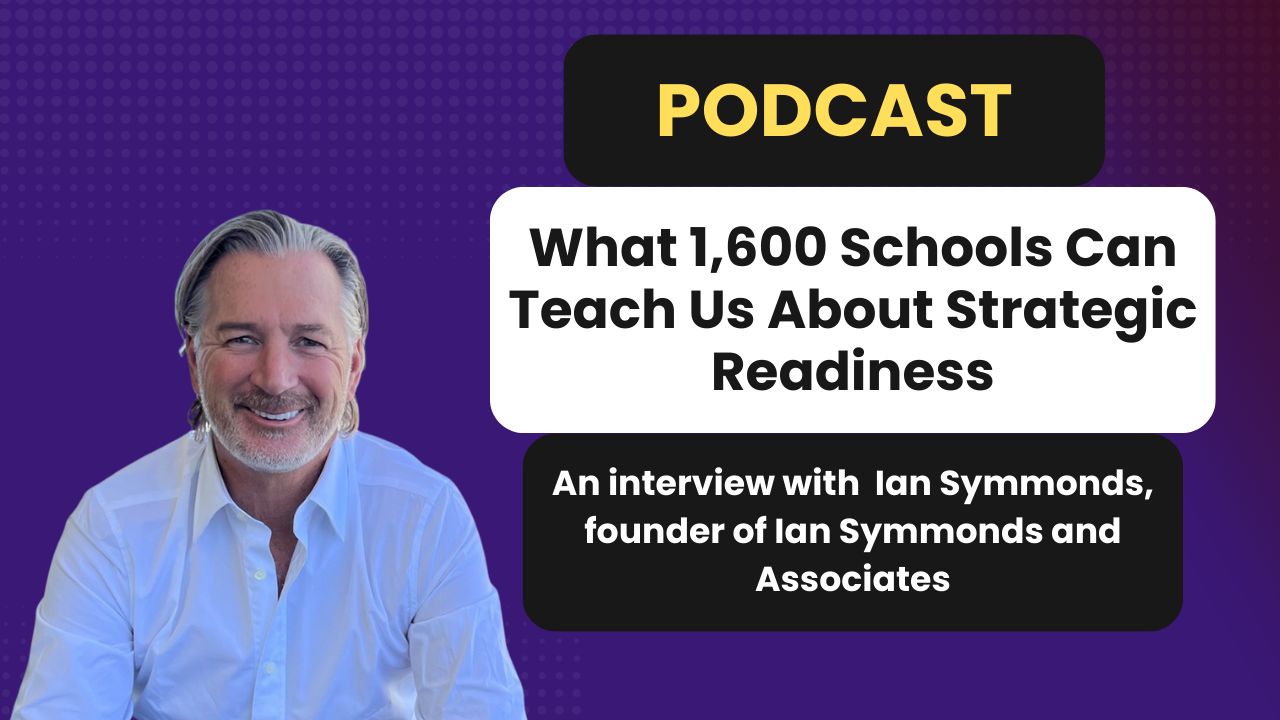
This tension is exactly why I was so energized by my recent conversation with Ian Symmonds, founder of Ian Symmonds and Associates, on the Independent School Moonshot Podcast.
Ian has spent years studying strategic behavior in independent schools, and he brought a framework to our conversation that I think cuts right to the heart of this challenge: the Strategy Continuum.
The framework describes a spectrum of strategic orientation, from Preservationist on one end to Adaptive on the other.
Preservationist schools, as Ian described them, are often looking in the mirror. They are not just reviewing their programs. They are looking at their history, their traditions, their existing safe spaces, and asking those things to produce answers. They are relying on a playbook that worked in 2010 to solve the challenges of 2026.
Adaptive schools take a different posture. They still look at their programs, but they also look out the window. They study demographics. They pay attention to the economy. They watch how other industries are solving for human connection, for relevance, for enrollment in a world where every institution is competing for attention and trust.
The framing Ian offered stuck with me: preservationist schools look inside the building for answers. Adaptive schools look outside.
And here is the irony he pointed out that I have been thinking about ever since. Schools often slide into preservationist habits not during crisis, but during stability. Comfort breeds complacency. When things are going reasonably well, there is less pressure to question the playbook. And so the playbook ages quietly, year after year, until the environment shifts and the gap between what worked before and what works now is suddenly impossible to ignore.
What We Covered in the Episode
The conversation with Ian covered a lot of ground. A few of the themes that stood out:
Leadership is the lever. Schools move right or left on the continuum based on the alignment and strength of governance and executive leadership. The Head and the board have to be pulling in the same direction. Without that alignment, strategic positioning becomes a pendulum rather than a path.
The internal trap. Looking to your own history for answers is not inherently bad. But it can quietly block future relevance when it becomes the default. The question to ask is whether you are drawing on your history to inform the future, or using it as a substitute for actually looking at the future.
The playbook fallacy. Ian made a distinction I found really useful. Keep your core programs. Honor what makes your school distinctive. But update the manual on how you run them. The mission does not have to change. The operating logic often does.
Institutional vision. Vision has to outlast any single Head of School. One of the most common patterns Ian sees is a school that makes meaningful strategic progress under a strong leader, then drifts back toward the center of the continuum when that leader moves on. Continuity requires embedding the vision in governance and systems, not just in a person.
Motivation over money. This one surprised me a bit, but it rang true. Urgency, not endowment size, is what drives meaningful adaptation. Well-resourced schools are not automatically more adaptive. Sometimes the opposite is true. The pressure to change is a feature, not a bug.
Interrogating the myths. Every school has stories it tells itself. We are the school that... We have always been known for... Our families choose us because... Those stories are valuable. They are also worth interrogating, because they can become the biggest barriers to seeing clearly.
The Question Worth Sitting With
If your current strategy were written from scratch today, with today's demographics, today's technology, and today's parent expectations, how much of it would survive intact?
That is not a rhetorical question. It is worth actually working through.
Which assumptions are still solid? Which ones are you carrying forward mostly out of habit? Where is the gap between what the strategy says and what you are actually doing week to week?
The answer tells you something important about whether you are adapting or preserving.
Are you looking in the mirror or out the window?
Are you refining what exists, or preparing for what is coming?
That distinction, more than any tactic or program, is what separates schools that are building toward something from schools that are hoping the past holds.
Listen to the full episode with Ian Symmonds here: What 1,600 Schools Can Teach Us About Strategic Readiness.