
A Closer Look: The Implications of Declining Birth Rates on Independent Schools
The past several months of conversations with heads of school have covered a lot of ground.
Much of what I have written here has focused on how hiring and staff retention signal a stressed business model. But those conversations have surfaced other challenges worth naming directly: a new generation of parents with different expectations of school, tightening credit markets that are making debt restructuring increasingly complex, and growing reliance on tuition discounting to stay competitive.
Today I want to focus on one more: the declining birth rate.
It does not make headlines the way other issues do. But for independent schools dependent on enrollment to survive, it may be the most consequential demographic shift of the next two decades.
What the Data Actually Shows
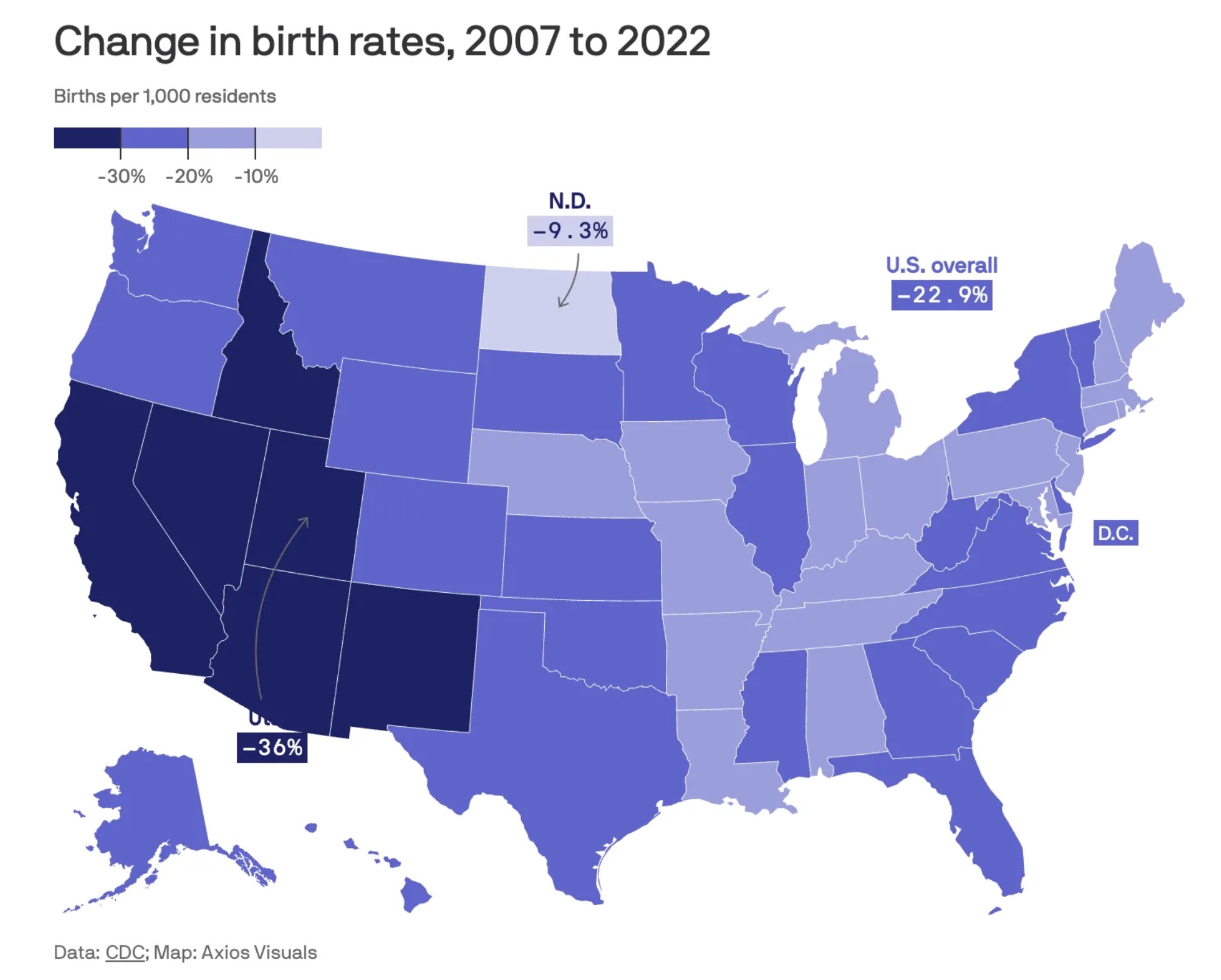
According to CDC data, the national birth rate dropped from 14.3 to 11.1 births per 1,000 people between 2007 and 2022. That is a decline of nearly 23 percent in fifteen years.
The reasons behind that decline, as cited in this Axios article, stem from a combination of economic factors and shifting societal norms. The cost of raising children has risen substantially. Financial security has become a prerequisite for family formation in a way it was not for prior generations. And more people are reconsidering the timing, and in some cases the decision itself, of having children at all.
These are not temporary fluctuations. They reflect structural changes in how people think about family, work, and financial stability.
What This Means for Independent Schools
The implications vary by region, but no school is entirely insulated.
If your school is located in an area benefiting from net population inflow, particularly parts of the Southeast, this may not be your most urgent concern right now. But even in high-growth regions, birth rates have declined in every state. The pressure may arrive later. It will arrive.
For schools in parts of the West or Northeast where outmigration is compounding the demographic decline, the math is more immediate. A shrinking pool of school-age children, combined with families leaving the region, means downward enrollment pressure is either already present or approaching.
The question is not whether to take this seriously. The question is how soon your school needs to act.
Four Places to Start
There is no single solution here, and any leader who tells you otherwise is oversimplifying. But there are concrete areas where schools can begin adapting now.
Get Serious About Local Demographic Data
National statistics tell the story at a macro level. What matters for your school is what is happening in your specific market.
Start by understanding your local birth rate trends, population movement patterns, and the competitive enrollment environment within your geography. This data exists and is accessible. Schools that are flying blind on local demographics are making enrollment projections and financial plans on assumptions that may already be wrong.
Rethink Long-Term Strategic Planning
Adapting to demographic shifts is not a marketing problem. It is a strategy problem.
Long-term planning needs to account for a smaller pool of traditional-age students. That means revisiting enrollment targets, rethinking revenue projections, and building strategies that do not assume steady or growing demand. It also means getting serious about recruiting diverse student populations and, for some schools, examining whether the current grade configuration or program scope still makes sense.
The Business Model Retreat is one way to surface these questions with your leadership team in a structured, focused session. It is built specifically to help schools examine their model honestly and identify where the real opportunities and risks live.
Evolve Your Marketing Approach
The families most likely to enroll students in independent schools over the next decade are millennials. They research differently, make decisions differently, and respond to different kinds of messages than prior generations of school parents.
Feature-and-benefit marketing does not move them. Values alignment does. If your marketing is still leading with program lists and campus amenities, it is time to make a shift. Lean into storytelling. Help prospective families understand who you are, what you believe, and what kind of community you are building. The families who resonate with that story will find you. The ones who don't are not your students anyway.
Innovate the Business Model Itself
This is the hardest and most important work.
A declining student pipeline puts pressure on tuition revenue, which is already the structural vulnerability of most independent school business models. Responding to that pressure with deeper tuition discounting is not a strategy. It accelerates the problem.
The schools that will navigate this well are the ones willing to think differently about revenue: auxiliary programs, facility utilization, fundraising infrastructure, alternative tuition models, and non-enrollment-dependent income streams. None of these is easy. All of them require the kind of honest business model analysis that most schools have not done in a structured way.
The School Operating System is built to help schools execute on exactly this kind of strategic shift, with the planning infrastructure and quarterly cadence to keep priorities moving rather than stalling after the retreat room clears.
Raise This with Your Team
If you have not already put demographic trends on the agenda with your leadership team and board, that is the place to start.
Not to create alarm. To create clarity.
The schools that will adapt well to this environment are not necessarily the largest or the best-resourced. They are the ones who see the trends clearly, plan honestly, and are willing to build a model that fits the reality ahead rather than the assumptions of the past.
Each school will chart its own course. But the work starts with the conversation.